

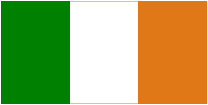
 Under the constitution of 1937, Ireland is a sovereign, independent, democratic state. It became a republic in 1949 when Commonwealth ties with Great Britain were severed.
Executive power under the Irish constitution is vested in a cabinet, which forms a government of some 15 members. The government is responsible to the lower house of the national legislature. A prime minister serves as head of government and is appointed by the president after nomination by the lower house. Members of the government head the administrative departments, or ministries. They are selected by the prime minister, approved by the lower house, and appointed by the president. The president of Ireland is the head of state and is elected by direct popular vote for a 7-year term. Legislature Ireland has a bicameral legislature known as the Oireachtas. The lower house, or Dail Eireann, is directly elected and now has 166 members. The upper house, or Seanad Eireann, has 60 members-11 appointed by the prime minister, 6 elected by university graduates, and 43 chosen by an electoral college of some 900 representatives from local governments and the national legislature. The slate of candidates represents labor, agriculture and fisheries, public administration and social services, commerce and industry, and national culture. The upper house is limited in authority, while the lower house has the power to support or bring down governments in the parliamentary tradition.
Judicial authority in Ireland is vested in a supreme court, a high court, a court of criminal appeal, a central criminal court, circuit courts, and district courts. The supreme court is the court of final appeal and plays a key role in constitutionality determinations. Judges are appointed by the president on the recommendation of the government.
County councils, county borough corporations, borough corporations, urban district councils, and town commissioners administer local services, including health and sanitation, housing, water supply, and libraries. Local officials are popularly elected, usually for 5-year terms. The local executives, who function as managers of local authorities, are selected by the central ministry after examinations.
The system of proportional representation by which members are elected to the Dail complicates elections. Ireland has a history of party mergers, splinter groups, and coalitions. Among the most powerful parties in recent years have been Fianna Fail, Fine Gael, the Progressive Democratic party, and Labour. Over the years, the prime minister has formed a number of governments without a clear-cut working majority.
Most health services are provided free of charge for low-income groups and at moderate charges for others, through local and national agencies, under the supervision of the department of health. A nonprofit, contributory voluntary health insurance scheme is administered by an independent statutory agency. Public insurance and assistance programs are administered by the department of social welfare and include pensions for the aged, widows, and orphans; children's allowances; unemployment benefits; and other social security items.
The active military forces of Ireland-army, navy, and air force-total 13,000 members. Reserve forces now number 16,100. The forces are all volunteers. *
Ireland is a divided country. The northern part is governed by Great Briatin, and is sometimes called Ulster, after its province name, though it is still offically called "Northern Ireland". The southern part, the Republic of Ireland, is independantly governed, though a close eye is kept on it by Great Britain.
Northern Ireland is a Catholic community, and enjoys being a part of Great Britain. The Republic of Ireland is Protestant, and would like to see a united Ireland, with the North and South being a self governing whole. The Republic of Ireland feels very much like Northern Ireland is an occupied territory, with Great Britain unjustly reigning with an iron fist. Northern Ireland enjoys being a part of Great Britain and would like to remain so, but Great Britain, interestingly enough, would like to release Northern Ireland.
Violence has often been used by all sides involved in this issue. From the south comes the IRA, to liberate the North from the evil empire. From the North comes many small factions (usually with the word "Ulster" in their group name) to defend the north against the IRA from the south. And both sides say Great Britain has turned on them in acts of violence.
The Irish Republican Army (IRA) is an outlawed Irish military organization founded in 1919 to fight British rule in Ireland. The IRA supported the aims of the Sinn Fein, an Irish nationalist society which also advocated independence from Great Britain, but the two groups operated separately. The IRA first engaged in guerrilla fighting in the war for independence in 1919-1922. Like the Sinn Fein, however, it split over the postwar settlement that established the Irish Free State. A small IRA faction accepted the settlement and became part of the army. The larger faction, then called the Irregulars, fought the Irish Free State government in the civil war of 1922-1923. Although it surrendered in 1923, the IRA continued to recruit and train members and periodically engaged in violent acts. It was outlawed in 1931 and again in 1935. After Ireland withdrew from the Commonwealth in 1948, the IRA turned its attention to removing British rule from Northern Ireland and establishing a unified Irish republic. In the late 1960s Northern Irish Roman Catholics began a forceful campaign for improved economic and political status. Support for the IRA then grew, and IRA attacks against Protestant activists and the British army escalated. Disagreement in 1969 over use of terrorist tactics led to a split into two groups: a radical group, the Provisional IRA, which carried out assassinations and other terrorist activities; and the main group, the Official IRA. On August 31, 1994, after 25 years of fighting, the IRA declared an unconditional cease-fire, promising to suspend military operations in favor of peace talks.
Unfortunately, the IRA has decided that it can no longer maintain its cease fire. The following articles were clipped from An Phoblacht/Republican News, Ireland's biggest selling political weekly newspaper.
THE FULL TEXT of the Irish Republican Army's statement issued at 5.41pm on Friday, 9 February 1996 reads as follows:
``It is with great reluctance that the leadership announces that the complete cessation of military operations will end at 6pm on 9 February. ``As we stated on August 31 1994, the basis for cessation was to enhance the democratic peace process and to underline our definitive commitment to its success. We also made it clear that we believed an opportunity to create a just and lasting settlement had been created. ``The cessation presented an historic challenge for everyone and the Irish Republican Army commended the leadership of nationalist Ireland at home and abroad. They rose to the challenge. The British prime minister did not. ``Instead of embracing the peace process, the British government acted in bad faith, with Mr Major and the unionist leaders squandering this opportunity to resolve the conflict. ``Time and time again over the last 18 months, selfish party political and sectional interests in the London parliament have been placed before the rights of the people of Ireland. ``We take the opportunity to reiterate our total commitment to our republican objectives. The resolution of the conflict in our country demands justice. ``It demands an inclusive negotiated settlement. That is not possible unless and until the British government faces up to its responsibilities. ``The blame for the failure thus far of the Irish peace process lies squarely with John Major and his government.''
Signed: P O'Neill.
AT 7.01pm on 9 February a massive IRA bomb detonated at South Quay station beside Canary Wharf on the Isle of Dogs in London. Massive damage was caused to the area and two civilians, Inan Bashir and John Jeffries, were killed. IRA coded warnings about the location of Friday's bomb had been issued at 5.41pm allowing British police an hour and twenty minutes to evacuate the area. The warnings included one to RTE in Dublin, while several others were also communicated to other news agencies in Belfast and Dublin. A warning relayed to the Irish News in Belfast stated the bomb's location as: ``South Quay Station, Marsh Wall, Isle of Dogs, London''. Scotland Yard and the RUC were thus aware of the precise location of the device. The statement also warned: ``Immediate evacuation.'' Following the huge blast a further statement from Oglaigh na hEireann was released shortly before 1pm, Saturday 10 February.
It read:
``Volunteers of Oglaigh na hEireann planted the bomb which exploded in Canary Wharf in London. They did so under the direct instructions of the army leadership. The regrettable injuries could have been avoided had the British security forces acted promptly on clear and specific warnings.''
The bodies of the two civilians were found in the rubble of the blast at 8pm on Saturday.
The massive damage caused by the bomb will run into tens of millions of pounds, stated John Gale a director of Harris Claims insurers who has clients in the area. The buildings, mostly office blocks, which took the brunt of the blast were the Beaufort Court, Euro Trade Centre, South Quays 1, 2 and 3. The South Quay Plaza was totally destroyed.
Badly damaged companies included Builder House owned by Builder Group Plc, Midland Bank, Guardian Printworks, Bell Cable Media (the third largest cable TV and telecommunications company in Britain), and South Quay railway station.
``The damage is severe'' said Gale. ``There is going to have to be a certain amount of controlled demolition.'' Estimates by the Association of British Insurers say the damage may be as high as £150 million.
Despite the IRA warnings only four London police officers were directed by Assistant Commissioner Anderson Dunn to clear the station, while train services south, beyond Canary Wharf, were only suspended at 6.pm.
Over the next hour 16 more police officers were sent to the area.
Dockland workers and residents of the Isle of Dogs asked why so many people were on the Quay when the bomb, which killed two men and injured over 50 others, exploded although nearby office blocks were evacuated a full 45 minutes before the blast. Residents were told nothing.
Tony Ashkins, of Albert Grove, said: ``If they knew about the bomb an hour before it happened, then why didn't they put a warning on the early evening news.''
Father Christopher Owens of St Lukes, Barkentine Estate said:
``Planting the bomb was of course wrong, but the nationalist community must be very angry with John Major for wantonly throwing a spanner in the works of the peace process.''
Neville Walker, one of those injured said that he had been evacuated from his offices a few yards from the seat of the blast, only to be told he could go back 10 minutes later. He was at his desk on the fourth floor at Franklin Mint 30 minutes later when the explosion wrecked the building. Other workers in this building had gathered outside the rear of the building, 50 yards from the bomb, but were allowed back in again several minutes later.
Many others described how the police did not suggest any sense of urgency, with people ambling about near the truck containing the explosives.
Carolyn Vautier, another office worker had actually been trying to buy a ticket at South Quay station minutes before the blast while Steve Holmes, owner of the nearby Tradewinds bar, said: ``No-one had said a word to us and people were coming and going freely.''
A spokeswoman for Scotland Yard revealed that it was their policy not to evacuate office blocks nor presumably the newsagency at the location where the IRA had warned the bomb was. It was here the two men died.
It emerged that while some buildings were evacuated, others were alerted to the danger but people were told to stay inside. Several businesses that did not receive warnings said they would seek meetings with the London police authorities as soon as possible.
Thatcher's showpiece Canary Wharf development, which she opened, has recently been rescued by a consortium of banks, but the explosion is likely to make the 2.8 million square feet of empty property even harder to let.
Just days before the attack, at a lecture organised by the Corporation of London, British Deputy Prime Minister Michael Heseltine, he described London as one of the world's top financial capitals, employing 600,000 people.
Heseltine said London carried out foreign exchange deals worth 450 billion dollars a day, more than the US and Japan put together. London he concluded was the Eurobond dealing capital of the world and in 1994 over half of the international equity trading was carried out there.
``The City of London remains the powerhouse of the British economy, and if capital could somehow be induced to flee, then the country would be sorely damaged,'' said the Daily Telegraph' City Comment on Monday.
"Ireland, Republic of," Microsoft (R) Encarta. Copyright (c) 1994 Microsoft Corporation. Copyright (c) 1994 Funk & Wagnall's Corporation.